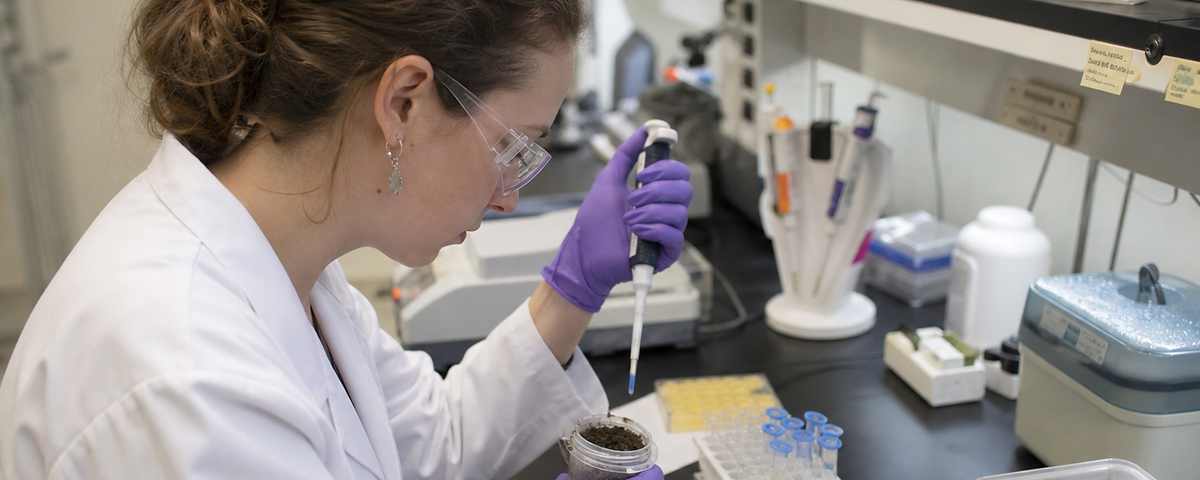
Soil sample preparation typically involves three stages: pretreatment, homogenization, and extraction. The correct workflow depends on the soil type, target molecule, and downstream application. For microbial DNA analysis, samples should generally be kept cool, homogenized consistently, and purified to remove PCR inhibitors such as humic acids.
Soil microbial communities can change between collection and extraction. To help maintain sample integrity between collection and extraction, process fresh soil whenever possible and keep samples cool during handling. When immediate processing is not feasible, preserve samples using Soil Preservation Solution (Non Lytic) (Cat. No. 116568100) or Soil Preservation Solution (Lytic) (Cat. No. 116567100) before proceeding with homogenization and nucleic acid extraction.
Soil sample analysis is an important step in many environmental research projects, such as those seeking to assess microbial diversity. Each soil sample has a unique makeup of biotic and abiotic components and may vary in chemical composition based on treatment with fertilizers and other additives. Soil sample preparation generally involves three stages: pretreatment, homogenization, and extraction.
Prepare the sample for effective homogenization. This can involve drying out or wetting the sample, removing large sample components (e.g. twigs, stones, etc.) by sifting the sample through a mesh sieve of a particular size or manual removal, and grinding to loosen up any clumps. Pretreatment can change the chemical composition and microbial viability of a sample. Additionally, it can change how representative a sample is for the area under investigation. Depending on your application and sample type, pretreatment may not be necessary.
A common cell biology and molecular biology process where a sample is disrupted so all sample components become equal in particle size. It is performed to sufficiently lyse tissues or cells to maximize yield of target molecules, such as proteins, DNA, or RNA.
The processes of isolating and purifying a target analyte, such as DNA, so it is ready for use in downstream analysis.
The specific protocol within each stage varies based on sample type and downstream application.
The kit is designed for efficient extraction of high-quality microbial DNA from challenging environmental samples, including high- and low-biomass soils. Its optimized workflow combines effective mechanical lysis with inhibitor removal to help reduce contaminants such as humic acids, producing purified DNA suitable for downstream applications including PCR, qPCR, 16S/ITS analysis, and sequencing.
The SPINeasy® 96-Well DNA Pro Kit for Soil and SPINeasy 96-Well DNA/RNA Kit for Soil enable high-throughput processing of up to 96 soil samples without the need for an automated extraction instrument. Using a 96-well membrane-based format with centrifugation or vacuum processing, it offers an accessible way to scale up soil DNA purification while maintaining the performance of the SPINeasy workflow.
Meet the newest member of the FastDNA kit family, the MagBeads FastDNA Kit for Soil. MagBeads offers a workflow that can be performed manually or integrated with compatible automated nucleic acid extraction instruments, making it particularly attractive for laboratories looking to streamline or scale sample processing. The kit also includes reagents designed to remove common soil contaminants such as humic acids, polysaccharides, phenolic compounds, and other enzyme inhibitors, producing DNA ready for downstream molecular applications.
| Soil Type | Sample Quantity | Lysing Matrix | FastPrep 24-5G Speed | FastPrep 24-5G Time |
|---|---|---|---|---|
| Soil/Rock | 50 mg | E | 5.5 | 2 x 30 sec |
| Sandy Sample | 50 mg | E | 4.0 | 4 x 30 sec |
| Litter | 50 mg | E | 5.5 | 40 sec |
| Brunisol – Dark Gray Luvisol | 500 mg | E | 5.5 | 2 x 30 sec |
| Soil from Grassland | 500 mg | E | 5.5 | 2 x 30 sec |
| Rhizosphere | 500 mg | E | 6.0 | 40 sec |
| Marine Sediment | 500 mg | E | 5.5 | 2 x 40 sec |
| Asphalt-permeated Soil | 500 mg | E | 6.0 | 40 sec |
| Low DNA yield | Few microorganisms present in the sample, protease or contaminant degradation, or aggregation from heat generated during bead beating | Use fresh soil where possible, keep samples cool before and during processing, and confirm the lysing matrix isn’t overly aggressive for the sample type |
| PCR/qPCR inhibition | Humic acid, polysaccharide, or phenolic carryover from soil | Add an inhibitor-removal or additional purification step before downstream use |
| Fragmented DNA / low molecular weight | Lysing matrix is too aggressive, causing excess physical shearing | Switch to a lower-shear, medium-impact matrix such as Lysing Matrix E |
| Sample overheating | Long, uninterrupted bead-beating cycles | Use shorter cycles with cooling intervals between runs, and chill samples beforehand |